03 / Apertures and distribution
Openings That Draw Shadows
A hole in clay is not only a missing piece. Once the lamp is lit, it becomes a small instrument for directing light.
Start with the wall, not the wattage
Watch the lit wall beside a pierced pendant. Some openings appear as small bright points, while others stretch into ovals or merge into a loose wash. Their appearance depends on the geometry of the shade, the position of the source and the surface receiving the light. The ceramic pattern alone does not determine the final projection.
Move the same lamp away from a wall and its pattern may enlarge, soften or become too faint to read against the room’s other lighting. Move your chair and the source itself may become visible through an opening. A successful effect therefore belongs to a relationship between lamp, room and observer rather than to the object in isolation.
Opacity and translucency do different work
An opaque ceramic wall blocks direct transmission and sends useful light through its openings. An open-bottomed shade can concentrate illumination below while leaving the upper room relatively dim. A pierced body adds lateral light but does not necessarily deliver enough illumination for reading or food preparation.
Some thin porcelain bodies transmit light diffusely. The effect depends on composition, thickness, maturity and surface treatment. A translucent shell can glow without acting like a clear window. Thicker areas may remain darker, making relief or changes in wall thickness visible as tonal differences. Ask to see the actual object illuminated; a photograph of another porcelain lamp is not evidence of the same behaviour.
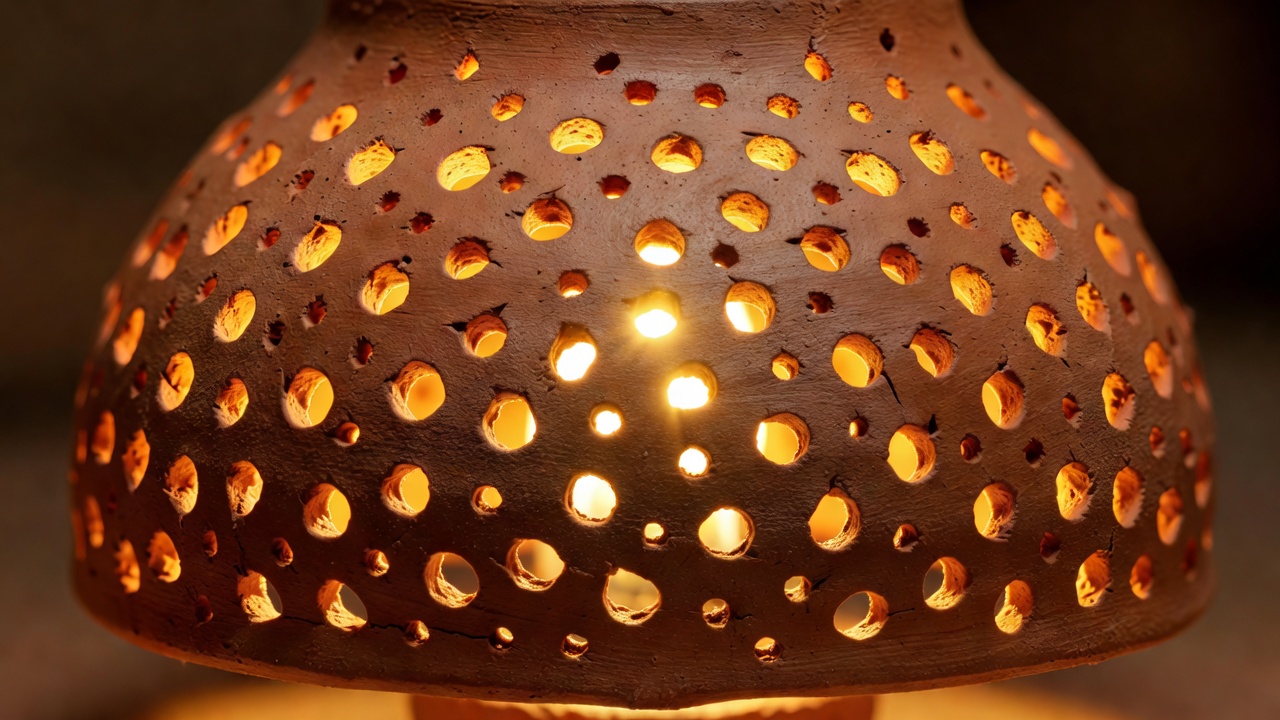
An opening is a short tunnel
Wall thickness gives a pierced opening a channel. A deep, narrow channel can restrict the angles at which direct light escapes. A shallow, broad cut permits a different view of the source. Bevelled edges, irregular cuts and curved walls complicate that relationship further. This is why two shades with similar surface patterns can behave differently when lit.
Spacing also changes both appearance and construction. Large openings leave less ceramic between them; tightly clustered cuts can create vulnerable bridges. The maker has to reconcile the desired projection with drying, firing and handling. A convincing design does not require the smallest possible openings. It requires openings that do their intended work without making the object unnecessarily fragile.
The source redraws the pattern
A relatively small emitting area tends to produce more defined shadow boundaries than a broad emitting area in otherwise comparable geometry. A frosted bulb or diffuser can soften the pattern because light reaches an edge from multiple directions. LED lamps contain different arrangements of emitters, so two products with similar lumen output may cast noticeably different shadows.
The source’s position inside the shade changes the rays reaching each opening. A bulb extending below the rim can produce glare even if the ceramic body looks substantial. Do not alter a lampholder or improvise an extension to chase a photographic effect. Ask which source shape, size and position the finished fitting was designed to use.
| Intended effect | Key relationship | Check in the room |
|---|---|---|
| Patterned wall light | Openings, source size, wall distance | Is the pattern visible with other lights on? |
| Downward pool | Rim depth and source position | Is the source hidden from seated eyes? |
| Glowing porcelain | Body composition and thickness | Does this particular object transmit light? |
A beautiful shadow can be an atmosphere. It is not automatically useful task lighting.
Read colour and brightness separately
Lumens describe emitted luminous flux; watts describe electrical power. Neither value alone tells you how much light reaches a book under an opaque shade. Illuminance at the task, distribution, surface reflectance and the viewer’s needs all matter. Correlated colour temperature describes the appearance of a source’s white light, not its brightness or a guarantee of colour rendering.
The International Commission on Illumination (CIE) develops lighting terminology and measurement frameworks. The Chartered Institution of Building Services Engineers (CIBSE) and its Society of Light and Lighting offer further professional context. For readers interested in the broader experience of dim interiors, Jun’ichirō Tanizaki’s In Praise of Shadows is a literary companion rather than a technical specification.
Make a simple observation before committing
Ask for a demonstration with the intended lamp source. View the object from seated and standing positions, then compare it with the other room lights on and off. Observe the nearby ceiling and wall as well as the table. Keep exposure differences in mind when comparing photographs: a dramatic dark background can exaggerate a modest projection.
If the lamp will support a specific task, consider that task separately from its decorative effect. A second, less theatrical light may be the most comfortable companion. The aim is not to remove shadow, but to decide where shadow belongs.