02 / Firing, glaze and surface
What Heat Leaves Behind
After dark, a glaze becomes more than a colour. It is a field of reflections, shallow shadows and evidence of heat.
Look across the surface
Move a light source to one side of a ceramic lamp and its surface changes. A ridge that appeared modest in daylight may cast a distinct line. A glossy patch may catch a bright reflection while the surrounding body recedes. This raking view is a useful way to distinguish texture from a printed or evenly coloured finish.
The final surface depends on the clay body, preparation, coating, firing schedule and kiln atmosphere. These variables interact. A glaze name or a photograph taken in one studio cannot predict exactly how another piece will look in your room. Ask for unlit and illuminated views, ideally with the intended lamp source rather than a dramatic photographic substitute.
Firing is more than a peak temperature
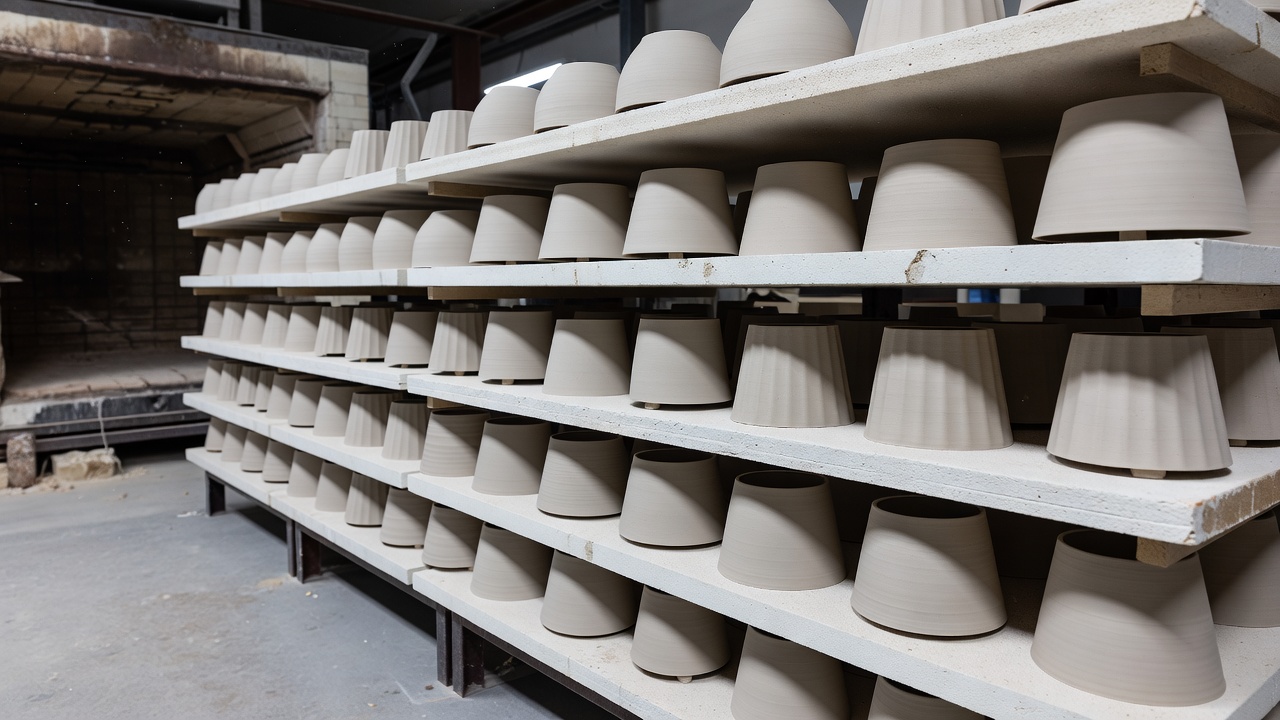
A common studio sequence includes a first, or bisque, firing followed by glazing and a further firing. Single-firing approaches also exist. During firing, the body undergoes irreversible changes and may densify as it matures. The suitable schedule depends on the body and surface materials, not simply on how pale or rustic the object looks.
Time as well as temperature contributes to heatwork. Pyrometric cones, associated with the Edward Orton Jr. Ceramic Foundation, help makers observe heatwork inside the kiln. They do not turn an unsuitable clay-and-glaze combination into a suitable one. Placement, atmosphere and cooling can all influence the result.
Separate the coating from the body
A slip is a clay-rich suspension that can alter surface colour or build texture. An engobe is another clay-based coating, formulated for a particular body and application. Sgraffito removes part of a contrasting coating to expose the layer beneath. Carving changes the physical relief of the object and can become especially visible under light from the side.
A glaze forms a glassy surface during firing, although its appearance may range from highly glossy to matte. Opacity, crystals, bubbles and application thickness influence what you see. Matte does not automatically mean soft to the touch, and gloss does not automatically mean the surface is flawless. For a lamp, the inside finish can matter too: it changes how stray light reflects within the shade.
| Surface | What light may reveal | Useful check |
|---|---|---|
| Gloss glaze | Concentrated reflections | View from the normal seated angle |
| Matte glaze | Subtle shifts in contour | Ask about cleaning and marking |
| Carved or textured body | Small, directional shadows | Inspect edges and dust access |
| Unglazed body | Clay colour and tool marks | Confirm the recommended dry-cleaning method |
Understand the marks without excusing everything
Crazing is a network of cracks in a glaze, commonly related to the fit between body and glaze. Crawling leaves areas where glaze has pulled away. Pinholes are small surface openings that may have several causes. These terms describe different conditions. A maker may pursue a crackled appearance deliberately, but an intentional surface effect is not permission to ignore sharp edges, loose fragments or structural cracks.
Glaze that flakes away at an edge deserves particular attention because detached fragments can be sharp. Stop using a damaged object and ask the maker to assess it rather than trying to seal or sand it yourself. A photograph may help an initial discussion, but it cannot always distinguish a superficial mark from a deeper crack.
“Handmade” explains a process. It does not, by itself, explain whether a surface condition is intentional or acceptable.
Atmosphere, variation and the finished lamp
Oxidation and reduction firing conditions influence certain colourants and surfaces. Wood firing can introduce ash deposits and directional effects; raku processes can create striking contrasts and crackled surfaces. Neither technique alone tells you the strength, absorption or suitability of a finished lighting component. The particular object and its assembly still need evaluation.
For historical surface references, explore the Ashmolean Museum, the British Museum and the Potteries Museum & Art Gallery. Nigel Wood’s Chinese Glazes and Daniel Rhodes’s Clay and Glazes for the Potter offer further material context. Historical recipes and objects are references, not ready-made specifications for contemporary electrical products.
Finally, keep firing temperature separate from service conditions. A ceramic component surviving a kiln does not mean that its cable, adhesive, lampholder or finish can tolerate unrestricted lamp heat. The complete luminaire’s instructions govern use. A convincing surface is one part of a successful object, not proof that every other requirement has been met.